How Do You Choose High-Purity Sweet Potato Starch for Noodles?
Buyers comparing starch offers tend to get three documents back, and they are nearly always the same: a national standard, a grade name, and a promise of stable quality. The differences hide in the distance between a measured value and the ceiling it is measured against, which is why choosing high-purity sweet potato starch is less about reading a catalogue than about reading that distance.
Two numbers decide whether the noodle holds
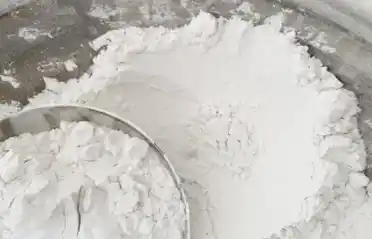
GB/T 34321-2017 caps premium-grade protein at 0.10% on a dry basis and ash at 0.30%, alongside a 100-mesh pass rate of at least 99.5%, whiteness of at least 82.0% at 457 nm, peak viscosity of at least 500 BU and a pH between 6.0 and 8.0. Residual protein holds water unevenly, so a sheet dries at different speeds across its width; ash is the fine grit that never fully gelatinises, and it is what turns a sauce grainy on the tongue. Neither number shows up in a sample bag.
Read a lot report as a distance, not a pass stamp
A 25 kg lot dated 12 October 2025 came back at moisture 12.3%, ash 0.22%, protein 0.08%, specks at zero, a 99.7% pass through 100 mesh, whiteness 87.3% and peak viscosity 678 BU, with lead, total arsenic and sulphur dioxide below the limits of quantification. Every figure sits inside the ceiling with room left, and that room is what absorbs a wet harvest or a slow drying day. A supplier landing exactly on the limit has no margin left to give you.
What to verify before the first container
Ask for the certificate of analysis for the lot you are buying, with a lot number that matches what is printed on the bag. Then check the licence, SC12313032400413, held by Qinhuangdao Tongyou Potato Industry Co., Ltd. in Lulong County and valid to 28 April 2027, and the HACCP certificate 001HACCP1900278 from China Quality Certification Centre, in force to 16 April 2028 and covering both the starch line and the noodle line. A third-party report is a separate request: it follows internal release testing and arrives later by nature, twenty items judged one by one rather than a single overall pass.
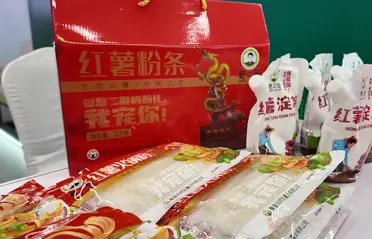
Commercial terms belong in the same conversation. A 20-foot container takes 22 to 25 tonnes, loading at Tianjin, with 7 to 15 days from deposit confirmation and 1 to 2 kg samples drawn from production lots and sent with the matching report.
What the sheet will never say
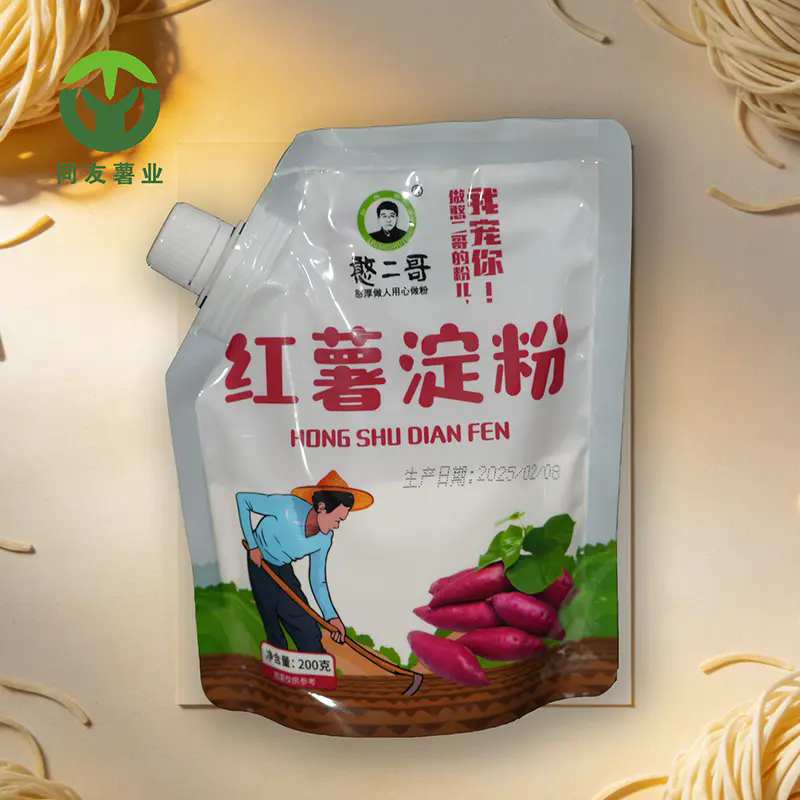
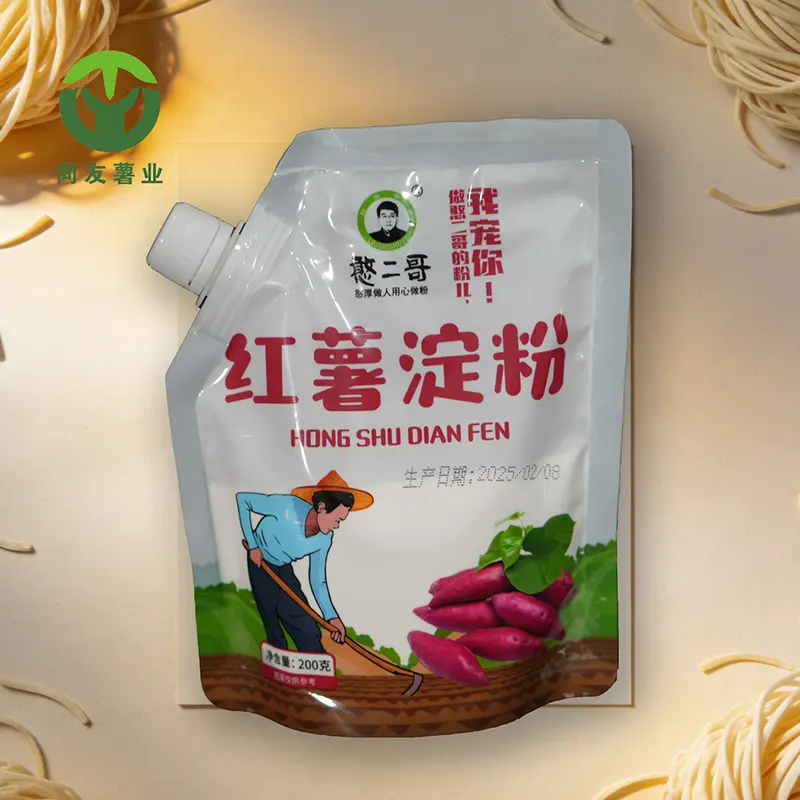
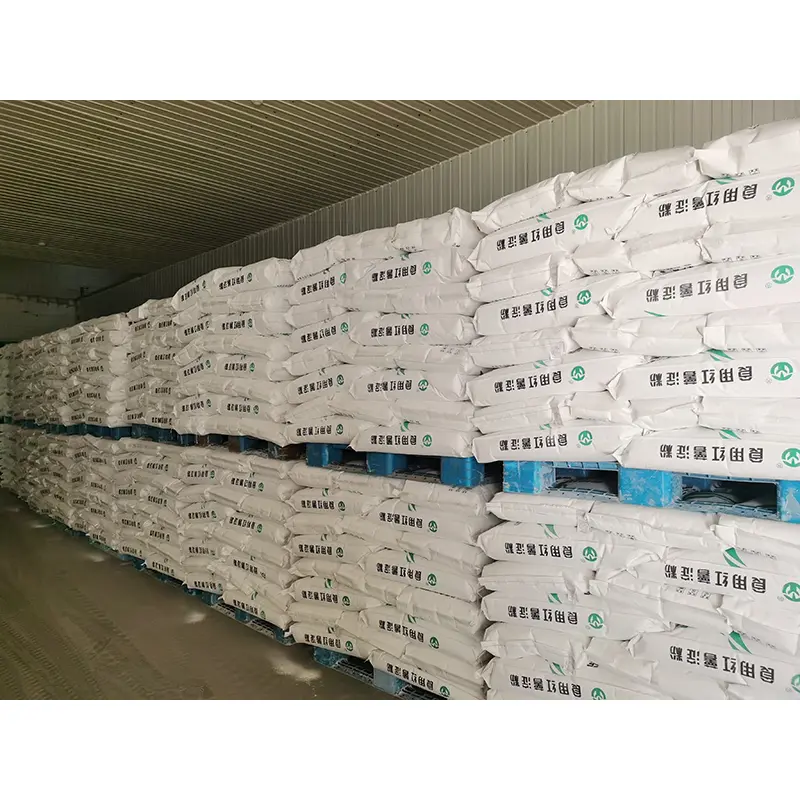
Moisture gained in transit is the quietest risk in starch trading. A bag leaving the plant at 12.3% can sit above the ceiling after a humid crossing, and no certificate covers that; 25 kg goes into a food-grade liner inside a laminated woven bag, palletised for the container, while retail runs in 200 g stand-up pouches. Seasonality is the other blank. Starch is made in a harvest window and sold all year, so a supplier's stock position in June was decided in October, and volume planning should come before price.
A spec sheet is a starting point, not an answer. Source high-purity sweet potato starch on the evidence behind the numbers, and the noodle line will not need a fresh recipe every time a pallet arrives.
Related News
- Sweet Potato Starch vs Cassava and Corn: Which Thickens Best?
- How Do Sweet Potato Starch Plants Keep Supply Steady All Year?
- How Long Should You Soak Sweet Potato Vermicelli Before Cooking It?
- Where to Source Trusted Sweet Potato Starch and Sweet Potato Vermicelli From Chinese Agricultural Exhibitors?
- How Can Businesses Source Reliable Sweet Potato Vermicelli from China?
- Why Does Sweet Potato Starch Quality Affect Noodle Texture?
Leave me a message
New Products



News Recommendations